Quote of the Day

THEION ARTICLES

theionarticles.blogspot.com && speaka1000words.blogspot.com

Wednesday, January 20, 2016

Air'crafts'

Must you raise your window shades during take-off and landing?

Yes, the seatbelt is essential and so is straightening your seat and folding back your tray table. But do you really have to raise your window shades?

Here’s what you need to know:

Take-off and landing are the trickiest stages of the flight. This is when things are most likely to go wrong, if at all. Cabin crew are required to prepare the aircraft for any contingencies. Apart from ensuring that able-bodied persons man emergency exit doors, they also ensure that passengers are buckled up, electronic devices switched off and bags safely stowed in overhead bins. And then there are those window shades.

In case of an emergency, protocol requires cabin crew to get everyone out of the aircraft in just 90 seconds. Raising the window shades and adjusting cabin lights ensures that your eyes are well-adjusted to the light outside. In an emergency, you will be able to assess the situation outside without wasting crucial seconds. Raising window shades also gives rescue personnel better visibility inside the craft. In short, this could be the difference between life and death.

Plus, it always helps to have an extra pair of eyes. During take-off and landing, passengers have better visibility of the wings and other parts of the aircraft. In case of trouble, they can spot it early and raise a flag.

So try not to be grumpy the next time you’re woken up just to raise your window shades. Someone’s probably saving your life.

On the topic of aircraft windows, do you know "Why do aircraft windows have rounded edges?"

Short answer: to keep you alive

It may not seem so, but the rounded window design is one of the crucial safety features of an aircraft, perhaps more important than your seat-belt and that life-jacket that you hope never to reach for.

Commercial passenger aircraft usually fly at altitudes over 30,000 feet, where air pressure is very low. This can cause severe health complications. To prevent this, pilots turn a knob to maintain a steady air pressure inside the cabin. However, as the aircraft climbs, the pressure inside the cabin becomes much higher than what it is outside.

While the metal fuselage can easily endure this stress, it is the windows that pose a bit of a problem. Stress tends to concentrate towards the edges, which is why surfaces with sharp corners crack easily. With rounded corners, the force is evenly distributed across the pane, making your window virtually shatter-proof.

It is a physics lesson the aviation industry learned the hard way at the start of the jet-age. The first commercial jet-liner, the de Havilland Comet, was built with square windows. In 1954, two years into service, a flight carrying 26 passengers and nine crew members crashed shortly after taking off from Rome. Two years later, another aircraft of the same make met the same fate. In both cases, it was metal fatigue around the windows that ripped the fuselage mid-air.

That was then. Today, aircraft windows are designed to handle loads way beyond what they experience. They also come in a three-layer structure: a convex external window pane shielded by a middle layer buffered by an acrylic screen, which is what you smudge your nose against. There’s also a tiny pinhole in the middle layer, which releases some of the cabin pressure on to the outermost pane. This ensures that if the pressure gets too much to handle, it is the outermost window that will crack, and the middle layer will act as a buffer, ensuring you return to ground as planned.

Courtesy: cntraveller.in

Sunday, September 20, 2015

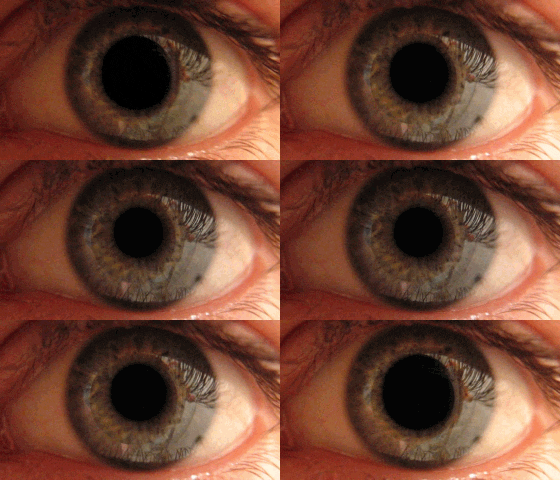
12 Unbelievable Facts About Human Eyes That You Didn’t Know!

Even as you read this, your eyes are working at an incredible pace and doing it silently and stealthily. Ask yourself though – how much do you know about this incredible organ? For instance, did you know that every time you light up a cigarette, you are reducing your night vision? Or that an average blink lasts 300-400 milliseconds?
Here are some other facts about human eyes, so that you can appreciate the superhuman strength of the deceptively simple human eye.
1. The focusing muscle of the human eye moves about 1000,000 times every day.

Eye muscles
Image Source
It’s crazy how much the focusing muscle of the eye gets done. On an average, this spectacular muscle of the human eye moves about 1000,000 times every single day. If that doesn’t blow your mind, let’s put it in perspective. For your leg muscles to get the same kind of workout, you would have to walk 50 miles, every day.

2. Until about 10,000 years ago, all human beings had brown eyes. Blue eyes are a more recent phenomenon caused by a genetic mutation, a sign that humans are still evolving.
Blue eyes
Image Source
Originally, every single human being had brown eyes. However, about 10,000 years ago, someone who lived near the Black Sea developed a genetic mutation that turned brown eyes to blue.  There are many theories about how blue eyes have still persisted, so many generations later. For instance, one theory suggests that blue eyes act as sort of a paternity test. This means that since there is strong evolutionary pressure on a man not to invest his paternal resources in another man’s child, he would actively seek out blue-eyed mates. Since it is impossible for two blue-eyed partners to create a brown-eyed baby, this instinct may have led to the genetic preservation of blue eyes.

3. How far can the human eye see? Assuming a flat earth and complete darkness, the human eye is sensitive enough to spot a candle flame, flickering up to 30miles (48 km) away.
How far eye can see
Image Source
Although the Earth’s surface curves out of sight at a distance of 3.1 miles (5 km), our ability to see extends far beyond that distance. If Earth were completely flat, or if you were standing on top of a mountain surveying a larger-than-usual patch of the planet, you could see bright lights that are hundreds of miles away! On a particularly dark night, you could even see a candle flame flickering in the distance, specifically up to 30 miles away.
The eye’s ability to perceive things in the distance depends on how many particles of light, or photons, an object emits. After extensive research, vision scientist Selig Hecht discovered that the absorption of 5 to 14 photons, or, equivalently, the activation of just 5 to 14 rod cells is enough to tell your brain that you’re seeing something. The farthest object that is visible to the naked eye is the Andromeda galaxy, wherein its constituent 1 trillion stars collectively emit enough light for a few thousand photons to hit each square centimeter of Earth every second.

4. Both our left and right eyes have independent blind spots.  
The human eye has a blind spot on the retina, at the point where the optic brain leads back to the brain. However, the wonderful thing is that the left and right eyes have blind spots that are aligned symmetrically. What this means is that one eye’s field of vision will compensate for the other’s loss of vision, most of the time.
Are you now wondering if you can locate the blind spots in both your eyes? Yes, you can. There’s a rather simple test that can help you identify the blind spot in each of your eyes. In order to find the blind spot on the right eye – shut your left eye, focus the right eye on a single point and see if anything vanishes from your line of sight, about 20 degrees to the right. That’s your blind spot. Repeat the same steps for your left eye.
In order to find the blind spot of the right eye, it is necessary to close the left eye, focus the right eye on a single point, and see if anything vanishes from vision some 20 degrees right of this point. The following diagram has a set of characters on the left hand side, and black circle on the right. Keeping your head motionless, with the right eye about 3 or 4 times as far from the page as the length of the red line, look at each character in turn, until the black circle vanishes.
right eye blind spot test

5. The human eye evolved from a plain spot of photoreceptive cells.

eye evolution
In fact, eyes went through a few stages of evolution, from photoreceptor proteins to the eye as we know it, today. The earliest predecessors of the eye were photoreceptor proteins, found in unicellular organisms, called ‘eyespots’. Eyespots can only sense brightness. Then, it became important for organisms to be able to discriminate the direction that light was coming from. This was made possible by the multicellular eyepatch, gradually depressed into a cup, which first granted the ability to discriminate brightness in directions, then in finer and finer directions as the pit deepened.
The development of the retina came next. When a photon is absorbed by the chromophore(part of a molecule responsible for its colour), a chemical reaction causes the photon’s energy to be transduced into electrical energy and relayed, in higher animals, to the nervous system. These photoreceptor cells form part of the retina, a thin layer of cells that relays visual information to the brain.
Then, things happened very quickly. The next stage was the discovery that reducing the width of the light opening became more efficient at increased visual resolution, than simply deepening the cup. These kind of eyes still lacked a cornea or lens which, sure enough, came to be in the next stage of eye evolution.
6. The human eye, an incredible organ, can distinguish about 10 million different colors.
one million colors
Image Source
Essentially, there are three primary colours – red, green and blue – that make up the millions of colors distinguishable to the human eye. Each eye contains three receptors, one for each primary colour, that are responsible for the creation of the experience of color, when stimulated in various combinations. This is known as the Young-Helmholtz Trichromatic Theory. Thus, it follows that those who have defective cones cannot see certain colours and are known to be color-deficient.

7. If the human eye was a digital camera, it would have a resolution equivalent to 576 megapixels.
human eye 576 mega pixel
Image Source
However, the eye is not like a single frame snapshot camera but, instead, like a video stream. The eye works tirelessly, moving rapidly in small, angular amounts so that it can continually update the image of what we are seeing in our brain. Considering we have two eyes, this power also gets multiplied by 2, which further increases the resolution and, thereby, the amount of detail we perceive. This basically makes our eyes more powerful than any digital camera, as the eye plus brain assembles a higher resolution image than possible, because of the number of photoreceptors in the retina. This resolution is roughly estimated at a whopping 576 megapixels.

8. Human corneas are so similar to shark corneas that they may, one day, be used as a replacement in human eye surgery.
shark eye
Image Source
Sharks can actually prove extremely useful to humans. Optometric researchers are investigating the possibility of using shark corneas as a replacement to human corneas in transplant surgeries. Apparently, shark corneas are rather similar to our corneas. If this were to become a reality, it would be path breaking.

9. Green-eyed people make up only 1-2% of the entire human population, and naturally occurring violet-colored eyes exist.
Green eyes
Image courtesy: Steve McCurry (Source)
If you know someone with green eyes, they are a part of very tiny percentage of the human population. While green eyes are dominant over blue eyes, there are very few people that carry the gene responsible for green eyes. Therefore, within the ‘light-eyed community’, the number of blue-eyed people greatly outnumber those with green eyes. Thus far, scientists have found evidence linking the presence of certain other traits, such as having red hair, or gender with the occurrence of green eyes.
Even rarer than green eyes are violet eyes. However, violet eyes are steeped in lots of mystery and surrounded by many myths.
10. No, carrots don’t make your eyesight better. This was actually a lie that the British came up with to cover up the fact that they had come with a new, cutting-edge technology, during WWII. 
Carrot eyesight myth
Image Source
Unfortunately, if you’ve been chomping on carrots in the hope that you can toss your spectacles away, once and for all, you’re going to be disappointed. This famous ‘cure’ for better eyesight is actually just an elaborate cover-up, a story of wartime espionage. During the World War II, British pilots had the advantage of a game-changing tool, RADAR, that let them spot their enemies at night. However, to ensure that their enemies did not find out about RADAR, and then copy it, they claimed that their pilots had high-carrot diets to thank for their night-time vision!

11. Lightning fast vision protein in the human body has been named after the adorable pokemon, Pikachu. 

Pikachurin protein
Image Source
The newly-discovered protein, Pikachurin, has been named after Pikachu, in honour of his blink-and-miss moves and electrifying powers. The team of 18 Japanese scientists who discovered Pikachurin all work at the Osaka Bioscience Institute. This newly-discovered protein is essential for eye-to-brain transmission of visual signals and also for the way the eye tracks moving objects, in its field of vision.
Essentially, without the fantastic Pikachurin, it can take upto three times longer for visual signals to reach the brain.

12. Humans get ‘red eye’ in photos because the flash reflects off of the blood vessels in our retinas. In dogs and other animals, eyes look green because they have an extra layer of cells behind their retinas.


The mystery of the frustrating red eye has been decoded. When taking photographs, if light reflects off of the blood vessels in our retinas, it gives us devilish, red-tinted eyes. Similarly, animals tend to take on an unnatural, ghostly green glow in photographs, sometimes. The reason their eyes look green is because they have a special layer of cells, either in or behind their retinas, that acts like a mirror in reflective light and helps them see better at night.
To make sure you never ruin another picture with ‘red eye’, try to shoot at an angle so that the light source is not directly above your camera.

Courtesy: http://www.unbelievable-facts.com

Monday, January 20, 2014

Rebooting Android device?

How Often Should You Reboot Your Android Device?

Most people don’t reboot their phone very often.
Personally, the only time my phone restarts is when it runs out of battery life away from the charger or when something catastrophic happens. Neither of those things happens very often.

But should people like me and you reboot their Android devices more frequently? Or is it an absolutely pointless function that does nothing to help Android?

Let’s find out!

Reasons to restart:
-Installing important Android updates (not just app updates)
-You’ve encountered a serious error, slowdown problem, or other issue
-Your phone feels laggy and slow and you think restarting will help
-You’re rooting your phone and booting into development mode

Reasons not to restart:
-It takes a while
-It drains battery life
-You can’t use your phone for about 2 minutes

Conclusion

You really don’t need to reboot your Android often or at all. The only time Android really needs to reboot itself is when it encounters a major kernel/OS problem. And in 90% of these cases, Android will detect an error and shut itself down anyway.

If you notice your device getting laggy or slow, it might simply be heating up. Restarting would fix that problem, but so would leaving your device unused on the desk for a few minutes.

At the end of the day, you can restart your Android phone or tablet as much as you want. But it really doesn’t do anything unless you’re installing important updates.

Read Source

Sunday, December 16, 2012

Copying large files to external hard drive/flash drive.

Yesterday, while copying some large files to an external hard drive, I was promptly issued this message by Windows:
The file “filename” is too large for the destination file system.
So I wondered to myself what could possibly cause this issue. My external hard drive had tons of free space, so why would I not be able to copy this file over?

Well, the reason for this problem is because my file was 4.3 GB in size and my external hard drive was formatted in FAT32 format. The max file size for FAT32 is 4GB. The max file size for FAT16 is only 2GB!
So how do you fix this problem? Well there are two ways you can go about it. You can either split the file into smaller pieces and then copy it to your external hard drive or you can convert the file system to NTFS, where there is no limit on file sizes. (If the external hard drive is empty, just format it in NTFS mode. Caution: Formatting with data will delete everything in the external drive if not empty)

Now you should be able to copy your large files by either splitting them or converting the hard drive to NTFS! Enjoy!

Courtesy - http://helpdeskgeek.com/help-desk/file-is-too-large-for-destination-file-system/

Saturday, September 29, 2012

Capital suggestion

Written by a Pakistani journalist about India . . . . . . .

Capital suggestion
By Dr Farrukh Saleem

Here's what is happening in India :

The two Ambani brothers can buy 100 percent of every company listed on the Karachi Stock Exchange (KSE) and would still be left with $30 billion to spare . The four richest Indians can buy up all goods and services produced over a year by 169 million Pakistanis and still be left with $60 billion to spare . The four richest Indians are now richer than the forty richest Chinese .

In November, Bombay Stock Exchange's benchmark Sensex flirted with 20,000 points . As a consequence, Mukesh Ambani's Reliance Industries became a $100 bill ion company (the entire KSE is capitalized at $65 billion) . Mukesh owns 48 percent of Reliance .

In November, comes Neeta's birthday . Neeta turned forty-four three weeks ago . Look what she got from her husband as her birthday gift:

A sixty-million dollar jet with a custom fitted master bedroom, bathroom with mood lighting, a sky bar, entertainment cabins, satellite television, wireless communication and a separate cabin with game consoles . Neeta is Mukesh Ambani's wife, and Mukesh is not India 's richest but the second richest .

Mukesh is now building his new home, Residence Antillia (after a mythical, phantom island somewhere in the Atlantic Ocean ) . At a cost of $1 billion this would be the most expensive home on the face of the planet . At 173 meters tall Mukesh's new family residence, for a family of six, will be the equivalent of a 60-storeyed building . The first six floors are reserved for parking . The seventh floor is for car servicing and maintenance . . The eighth floor houses a mini-theatre . Then there's a health club, a gym and a swimming pool . Two floors are reserved for Ambani family's guests . Four floors above the guest floors are family floors all with a superb view of the Arabian Sea On top of everything are three helipads . A staff of 600 is expected to care for the family and their family home .

In 2004, India became the 3rd most attractive foreign direct investment destination . Pakistan wasn't even in the top 25 countries .

In 2004, the United Nations, the representative body of 192 sovereign member states, had requested the Election Commission of India to assist the UN in the holding elections in Al Jumhuriyah al Iraqiyah and Dowlat-e Eslami-ye Afghanestan . Why the Election Commission of India and not the Election Commission of Pakistan? After all, Islamabad is closer to Kabul than is Delhi .

Imagine, 12 percent of all American scientists are of Indian origin; 38 percent of doctors in America are Indian; 36 percent of NASA scientists are Indians; 34 percent of Microsoft employees are Indians; and 28 percent of IBM employees are Indians .

For the record: Sabeer Bhatia created and founded Hotmail . Sun Microsystems was founded by Vinod Khosla . The Intel Pentium processor, that runs 90 percent of all computers, was fathered by Vinod Dham .

Rajiv Gupta co-invented Hewlett Packard's E-speak project . Four out of ten Silicon Valley start-ups are run by Indians . Bollywood produces 800 movies per year and six Indian ladies have won Miss Universe/Miss World titles over the past 10 years .

For the record: Azim Premji, the richest Muslim entrepreneur on the face of the planet, was born in Bombay and now lives in Bangalore . India now has more than three dozen billionaires; Pakistan has none (not a single dollar billionaire) .

The other amazing aspect is the rapid pace at which India is creating wealth . In 2002, Dhirubhai Ambani, Mukesh and Anil Ambani's father, left his two sons a fortune worth $2 . 8 billion . In 2007, their combined wealth stood at $94 billion . On 29 October 2007, as a result of the stock market rally and the appreciation of the Indian rupee, Mukesh became the richest person in the world, with net worth climbing to US$63 . 2 billion (Bill Gates, the richest American, stands at around $56 billion) . Indians and Pakistanis have the same Y-chromosome haplogroup . We have the same genetic sequence and the same genetic marker (namely: M124) .
We have the same DNA molecule, the same DNA sequence . Our culture, our traditions and our cuisine are all the same . We watch the same movies and sing the same songs . What is it that Indians have and we don't?

INDIANS ELECT THEIR LEADERS!!!!! !!!!!!!!! !!!!

And also to mention: They think of Construction of own nation, unlike other nations who are just concerned with destruction of others . . .

Simple answer to why the Indians far better than the Pakistanis - They don't focus on religion all the time and neither do they spend time and money in devising ways to kill their own and everyone else over religion .

Ten Amazing Coincidences

What's in a Name?
A computer error gave two women in America called Patricia the same social security number. When the two women were brought together in an office to rectify the blunder they discovered that
They had both been born with the names Patricia Ann Campbell
Both of their fathers were called Robert Campbell
Their birthdays were on 13th March 1941
They had both married military men in the year 1959 (within eleven days of each other)
They each had two children aged 19 and 21
They both had an interest in oil painting
Both had studied cosmetics
Both had worked as book-keepers
**************
Bullet With Your Name on It
In 1893, Henry Ziegland ended a relationship with his girlfriend.
Tragically, his girlfriend took the news very badly, became distraught and took her own life.
Her distressed brother blamed his sister's death upon Henry, he went round to Henry's house, saw him out in the garden and tried to shoot him.
Luckily, the bullet only grazed Henry's face and embedded itself in a nearby tree.
In 1913, twenty years after this incident, Henry decided to use dynamite to uproot a tree in his garden. The explosion propelled the embedded bullet from the tree straight into Henry Ziegland's head - killing him immediately.
**************
Lucky Hughs?
On December 5th 1660, a ship sank in the straights of Dover - the only survivor was noted to be Hugh Williams.
On 5th December 1767, another ship sank in the same waters - 127 lost their lives, the only survivor was noted to be Hugh Williams
On 8th August 1820, a picnic boat capsized on the Thames - there was one survivor - Hugh Williams.
On 10th July 1940, a British trawler was destroyed by a German mine - only two men survived, one man and his nephew - they were both called Hugh Williams.
**************
With a Quack Quack Here
Mr McDonald was a farmer who lived in Canada - nothing extra-ordinary in that - until you learn that his postcode contained the letter sequence EIEIO.
**************
'Til Death Did Them Part
In 1996, Paris police set out to investigate a late night, high speed car crash; both drivers had been killed instantly.
Investigations revealed that the deceased were in fact man and wife.
Police initially suspected some kind of murder or suicide pact but it became apparent that the pair had been separated for several months - neither could have known that the other would have been out driving that night - it was just a terrible coincidence.

**************


She's Behind You!

Michael Dick had been travelling around the UK with his family to track down his daughter, Lisa - who he had lost contact with ten years earlier.
After a long fruitless search, he approached the Suffolk Free Press, who agreed to help him by putting an appeal in their newspaper.
Fortunately, his long lost daughter saw the appeal and the pair were reunited. The odd thing was, his daughter had been right behind him when the free paper took the photograph ... What are the chances of that!

**************

Licensed To Thrill
A fifteen year old pupil at Argoed High School in North Wales was to sit his GCSE examinations in 1990.
His name was James Bond - his examination paper reference was 007.
**************
What Goes Around….
In 1965, at the age of four, Roger Lausier was swimming off a beach in Salem - he got into difficulties and was saved from drowning by a woman called Alice Blaise.
In 1974, on the same beach, Roger was out on a raft when he pulled a drowning man from the water - amazingly, the man he saved was Alice Blaise's husband.
**************
Lightning Never Strikes Twice?
British cavalry officer Major Summerford was fighting in the fields of Flanders in the last year of WW1, a flash of lightning knocked him off his horse and paralyzed him from his waist down.
He moved to Vancouver, Canada, six years later, whilst out fishing, Major Summerfield was struck by lightning again and the right side of his body became paralyzed.
After two years of recovery, it was a summer’s day and he was out in a local park, a summer storm blew up and Major Summerfield was struck by lightning again - permanently paralyzing him.
He died two years after this incident.
However, four years after his death, his stone tomb was destroyed - it was struck by lightning!
**************
Practice What You Preach
Businessman Danie de Toit made a speech to an audience in South Africa - the topic of his speech was - watch out because death can strike you down at any time.
At the end of his speech, he put a peppermint in his mouth, and choked to death on it!

Prevent Writing to USB Storage Devices

Prevent Writing to USB Storage Devices


Many system administrators have had some sleepless nights over this: it is too easy for users to connect a device (USB-key or MP3 player) to the USB port of a computer, and copy things off the system. This is an obvious security risk. This has been addressed in Service Pack 2 for Windows XP. You have to manually add the following registry key:

Start the Registry Editor
Go to the HKEY_LOCAL_MACHINE \ SYSTEM \ CurrentControlSet \ Control key
If there is no key called StorageDevicePolicies, create it. You do this by right-clicking the HKEY_LOCAL_MACHINE \ SYSTEM \ CurrentControlSet \ Control key, and selecting New > Key from the menu.

Select the StorageDevicePolicies key
From the menu select Edit > New > DWORD Value
Name the new value WriteProtect
Right-click the WriteProtect value and choose Modify
In the Value Data: box enter 1
Exit the registry editor, and restart your computer

To reverse, just delete the new WriteProtect value (or set the value to 0) and restart the computer.

Note: works on Windows XP Service Pack 2 only!

~~~~~~~~~~~~~~~~~~~~~~~~~~~~~~~~~~~~~~~~~~~~~~~~~~~~~~~~~~~

Courtesy & More info:


Monday, January 31, 2011

TRAI's new SMS Regulations,SMSing Policy Changes

New TRAI policy on Spam SMS is all set to create chaos?

Starting Feb 1st (2011), telecom operators will have to comply to new TRAI guidelines on SMS spam and while the deed is noble, it will create more confusion for consumers.

First, the fineprint.

- From Feb 1, there will only be 2 categories of messages- Transactional (Bank alerts, Railway & Airline alerts, Messages to parents from school etc) and Non transactional or Promotional (all remaining categories except mentioned earlier – like courier alerts, spam, marketing offers, news alerts, subscribed SMS services, intra company or group messages and so on)

- Only transactional messages will have full branded sender id (like TA-HDFCBANK) for others, there will be a 6 digit code (like TA-n12345 or TA-nABCDE), where n is the category of the message and further 5 digits are the unique code given by the telecom operator to each aggregator.

- All non-transactional messages will be compulsorily passed through the NDNC filter.(This means, you will NOT receive the subscribed/ paid news alert or even your courier status message if you are registered with DND) and will be allowed only during 9am to 9pm.

As a consumer, you will now have to open each and every non-transactional message to check on the content. So far, you could easily delete a message just by checking the names, but now ensure that you open each and every sms to see if there is something important.

Moreover, does this mean that you need to unsubscribe from DND to get other relevant & important messages (that TRAI considers non-transactional)?.

What’s your take? What will be the impact of this on bulk sms services? Operators have started testing this regulation – so chances of the implementation being delayed is minimal.

NCPR – Boon or Bust for SMS Pull services?

No doubt unsolicited calls and SMS have been a menace to Indian society for a long time. People from both sides of the table have lobbied extensively with the government to keep their side of the business running. TRAI created the National Do Not Call registry against this Unsolicited Commercial Communication (UCC), but without enforcement or awareness it just seemed like an half hearted attempt. But now with the new guidelines being laid down by the TRAI (now called NCPR) it appears that the government is indeed serious to curb this menace. Or is it?

NCPR appears to have sharper claws compared to NDNC by making the operator party to the UCC. Operator cannot get away this time by passing the blame on to the aggregator. The fines imposed on a complaint registered are quite steep to make both the operator and aggregator sit up and screen the messages being sent over their network. For Bulk SMSes, it defines two categories, Transactional and Promotional. Transactional SMS, according to their FAQ is any message sent by Financial institution, Railways, Airlines or Educational institutions to it’s registered users. Everything else is termed as Promotional.

It appears that the consumers are indeed going to be happy with this new guideline if implemented and enforced to the dot. But they will also not be able to use any of the pull services that they were used to due to this blanket ban on such communication. Google (SMS number 9 77 33 00000), Facebook (92-FACEBOOK) and our own direction services (90088 90088) rely on consumers sending a SMS, and the service replying to the requested sms. TRAI guideline does not talk about these services, and since the operators are going to term any Bulk SMS as a promotional SMS,

  • People registered in NCPR/NDNC will not be able use these services,
  • People will lose interactivity as the message now will not come from the virtual 10 digit number and
  • No one (even people not registered in NCPR/NDNC) will be able to use the service between 9PM and 9AM.

This guideline is definitely something good against the UCC, but it appears that not a lot of thought has been given while drafting it. TRAI seems unapproachable to any of our queries. It requests Tele-Marketer to register with http://www.nccptrai.gov.in after paying Rs 10,000/- and download the list of NCPR registered users for scrubbing, but the site just provides a CSV file with zero rows in it.

Is this yet another half hearted attempt by the TRAI to address Unsolicited communication? Is this going to kill the nascent industries banking on SMS pull services?

Only time will tell.

Courtesy: plugged.in

a Mail from way2sms.com, a free online SMS service provider informs the same:

Dear User,

As many of you may be aware, the Telecom Regulatory Authority of India (TRAI) recently issued new regulations on the SMS industry in India. These regulations are designed to significantly curb the sending of unsolicited commercial SMSes to consumers. Starting from Feb 1st 2011 every SMS service provider has to adhere to the new TRAI NCPR (National Consumer Preference Register (NCPR)) guidelines. Check www.nccptrai.gov.in for more details on new TRAI guidelines.

Being the Leader in the mobile messaging, Way2sms strictly adheres to TRAI guidelines from feb 1st in order to protect consumer privacy from SMS spammers. As part of implementing new TRAI guidelines, way2sms has worked tirelessly to further upgrade our internal processes, technology, and team to ensure 100% compliance of the new regulations.

In order to adhere to TRAI guidelines way2sms is also changing its messaging policies from 1st of Feb. 2011 onwards.

New Policies

* According to the New TRAI guidelines, No SMS provider is allowed to deliver SMSes to NDNC/NCPR listed mobile numbers. So, Starting from Feb 1st 2011 way2sms does not deliver SMSes to NDNC//NCPR Listed mobile numbers.
* TRAI New guidelines does not allow any service provider to use Numeric mobile number as the sender. So, Starting from Feb 1st, way2sms is changing its Message structure.


- All messages sent via way2sms will be sent as " TD- XXXXX" as the sender. No Longer you can use your mobile number as sender

- Your Mobile number and a 8 letter Nick name will be inserted in your message by default. However you can continue to enjoy 140characters message same as before. We thank you for your cooperation.

Best Wishes
WAY2SMS TEAM.

Link to check if your/your friends' mobile is registered under these services:

http://ndncregistry.gov.in/ndncregistry/search.misc
http://www.nccptrai.gov.in/nccpregistry/search.misc

Thursday, January 20, 2011

Kudos to TRAI - Mobile number Portability is here

Mobile Number Portability is here!!!

After a long wait, the mobile number portability (MNP) is finally here. Set for a nationwide roll-out today, MNP will usher in an era of new freedom for mobile subscribers in the country. The technology will allow subscribers to change their mobile service provider without the fear of losing their old mobile number.

This means users will be able to retain their old mobile number even after they decide to change their service provider. And yes, the service is available for both postpaid and prepaid customers and also on both GSM and CDMA platforms.

The consumer-friendly service was mooted over two years ago and was planned to be implemented by the end of 2009. However, implementation had to be deferred several times owing to reasons ranging from lack of preparedness of operators to delay in appointment of an agency to oversee MNP execution.

As per the eligibility criteria, there should not be any outstanding payment by way of pending bills before customers can apply for availing of MNP services, the Department of Telecom (DoT) said.

It also said that the mobile number sought to be ported should not be subjudice and also there should not be pending request for change of ownership of the mobile number.

The DoT has claimed that the entire process of switching operators would take a maximum of seven days and subscribers may face disruption of services for about two hours during that period.

"The maximum time period for porting would become seven working days except in Jammu & Kashmir, Assam and North East licensed service areas, wherein it would be 15 working days," the Telecom Regulatory Authority of India said in a statement.

Switch by high spending, post-paid subscribers, business subscribers could start another round of price war among operators. High-end users make up 5 per cent of the total subscriber base but generate around 20 per cent of revenue.

India has more than 700 million subscribers across the country with nearly 10 operators in each circle.

Customers willing to exercise the option of changing their service provider without change of number will have to follow the following simple steps.

Send an SMS to 1900 in following format: PORT - eg. PORT 9999999999.

You will get an SMS reply that contains a unique porting code from the existing service provider.(This code is valid only for a few days, and one must apply again if it expires.)

The customer can then make an application in the prescribed form (SMS to the preferred operator quoting the unique code) mentioning the code to the selected new service provider for porting of number.

Your existing operator will check with new operator & if there are no dues then approval will be given for porting.

You will get an SMS on the time and date when porting will take place. Rules mandate that process be completed within 4 days of applying. However a period of seven days has been prescribed for completion of porting (transfer) of the mobile number to the network of the new service provider.

After porting is complete, wait for an SMS from your new operator confirming the switch. Your phone may be dead for about 2 hours when the porting takes place.

Excerpts from the TRAI direction for the mobile service providers released on 10 Feb 2010:

A mechanism for the purpose of receiving Short Message Service messages from its subscribers requesting for a unique porting code which shall provide:-

(i) a Unique Porting Code consisting of 8 characters of which the first two shall be alphabets that denote the service provider code and service area code which have been specified by the Authority (for example: TD for Tata Teleservices Ltd in Delhi service area) and the remaining 6 characters shall contain 1 to 9, A-N & P-Z only, and small letters and the alphabet ‘O’ shall not be allowed;

(ii) the Unique porting Code allocated to a subscriber shall be valid for a period of fifteen days from the date of request or such time till the number is ported out, whichever is earlier, for all service areas except Jammu & Kashmir, Assam and North East licensed areas where the validity for the Unique Porting Code allocated to a subscriber shall be valid for a period of thirty days from the date of request or till such time the number is ported out, which ever is earlier, irrespective of. number of requests the subscriber makes; and,

(iii) the Short Message Service (SMS) text for requesting Unique Porting Code by a subscriber shall be the word ‘PORT’ followed by a space followed by the ten digit mobile number which is to be ported which shall be case insensitive. (i.e. it can be port or Port etc.) and in case the subscriber’s Caller Line Identification does not match with the ten digit mobile number, Unique Porting Code shall not be allotted but a message shall be generated to inform such subscriber that the Caller Line Identification does not match with the mobile number.

Courtesy: Times of India, NDTV, TRAI.GOV.IN

Friday, December 10, 2010

Top Level Domains in Internet

Country Code Top-Level Domains

A country code top-level domain (ccTLD) is an Internet top-level domain generally used or reserved for a country or a dependent territory.

ccTLD identifiers are two letters long, and all two-letter top-level domains are ccTLDs. Creation and delegation of ccTLDs is performed by the Internet Assigned Numbers Authority (IANA), and with certain exceptions corresponds to the ISO 3166-1 alpha-2 country codes maintained by the ISO 3166 Maintenance Agency.

List of ccTLDs

*=Foreign registration permitted

A
.ac – Ascension Island *
.ad – Andorra
.ae – United Arab Emirates
.af – Afghanistan
.ag – Antigua and Barbuda *
.ai – Anguilla
.al – Albania
.am – Armenia *
.an – Netherlands Antilles
.ao – Angola
.aq – Antarctica
.ar – Argentina
.as – American Samoa *
.at – Austria *
.au – Australia
.aw – Aruba
.ax – Aland Islands
.az – Azerbaijan

B
.ba – Bosnia and Herzegovina
.bb – Barbados
.bd – Bangladesh
.be – Belgium *
.bf – Burkina Faso
.bg – Bulgaria
.bh – Bahrain
.bi – Burundi *
.bj – Benin
.bm – Bermuda
.bn – Brunei
.bo – Bolivia *
.br – Brazil *
.bs – Bahamas *
.bt – Bhutan
.bv – Bouvet Island (not in use; no registrations)
.bw – Botswana
.by – Belarus
.bz – Belize *

C
.ca – Canada
.cat – Catalunya
.cc – Cocos (Keeling) Islands *
.cd – Democratic Republic of the Congo (formerly .zr – Zaire) *
.cf – Central African Republic
.cg – Republic of the Congo *
.ch – Switzerland *
.ci – Côte d'Ivoire (Ivory Coast)
.ck – Cook Islands *
.cl – Chile
.cm – Cameroon
.cn – People's Republic of China *
.co – Colombia
.cr – Costa Rica
.cu – Cuba
.cv – Cape Verde
.cx – Christmas Island *
.cy – Cyprus
.cz – Czech Republic

D
.de – Germany
.dj – Djibouti *
.dk – Denmark *
.dm – Dominica
.do – Dominican Republic
.dz – Algeria

E
.ec – Ecuador
.ee – Estonia
.eg – Egypt
.eh – Western Sahara (not assigned; no DNS)
.er – Eritrea
.es – Spain *
.et – Ethiopia
.eu – European Union (code "exceptionally reserved" by ISO 3166-1)

F
.fi – Finland
.fj – Fiji *
.fk – Falkland Islands
.fm – Federated States of Micronesia *
.fo – Faroe Islands
.fr – France

G
.ga – Gabon
.gb – United Kingdom (Reserved domain by IANA; deprecated – see .uk)
.gd – Grenada
.ge – Georgia
.gf – French Guiana
.gg – Guernsey
.gh – Ghana
.gi – Gibraltar
.gl – Greenland *
.gm – Gambia
.gn – Guinea
.gp – Guadeloupe
.gq – Equatorial Guinea
.gr – Greece *
.gs – South Georgia and the South Sandwich Islands *
.gt – Guatemala
.gu – Guam
.gw – Guinea-Bissau
.gy – Guyana

H
.hk – Hong Kong *
.hm – Heard Island and McDonald Islands *
.hn – Honduras *
.hr – Croatia
.ht – Haiti
.hu – Hungary *

I
.id – Indonesia
.ie – Ireland
.il – Israel *
.im – Isle of Man *
.in – India *
.io – British Indian Ocean Territory *
.iq – Iraq
.ir – Iran *
.is – Iceland
.it – Italy

J
.je – Jersey
.jm – Jamaica
.jo – Jordan
.jp – Japan

K
.ke – Kenya
.kg – Kyrgyzstan
.kh – Cambodia
.ki – Kiribati
.km – Comoros
.kn – Saint Kitts and Nevis
.kp – North Korea
.kr – South Korea
.kw – Kuwait
.ky – Cayman Islands
.kz – Kazakhstan *

L
.la – Laos *
.lb – Lebanon
.lc – Saint Lucia
.li – Liechtenstein *
.lk – Sri Lanka
.lr – Liberia
.ls – Lesotho
.lt – Lithuania
.lu – Luxembourg
.lv – Latvia *
.ly – Libya *

M
.ma – Morocco
.mc – Monaco
.md – Moldova *
.me – Montenegro
.mg – Madagascar
.mh – Marshall Islands
.mk – Republic of Macedonia
.ml – Mali
.mm – Myanmar
.mn – Mongolia *
.mo – Macau
.mp – Northern Mariana Islands *
.mq – Martinique
.mr – Mauritania
.ms – Montserrat *
.mt – Malta
.mu – Mauritius *
.mv – Maldives
.mw – Malawi *
.mx – Mexico *
.my – Malaysia
.mz – Mozambique

N
.na – Namibia *
.nc – New Caledonia
.ne – Niger
.nf – Norfolk Island *
.ng – Nigeria
.ni – Nicaragua
.nl – Netherlands *
.no – Norway
.np – Nepal
.nr – Nauru *
.nu – Niue *
.nz – New Zealand *
.nc.tr – North Cyprus *

O
.om – Oman

P
.pa – Panama
.pe – Peru
.pf – French Polynesia
.pg – Papua New Guinea
.ph – Philippines *
.pk – Pakistan *
.pl – Poland *
.pm – Saint Pierre and Miquelon
.pn – Pitcairn Islands *
.pr – Puerto Rico *
.ps – Palestine *
.pt – Portugal *
.pw – Palau
.py – Paraguay

Q
.qa – Qatar

R
.re – Réunion
.ro – Romania *
.rs – Serbia
.ru – Russia *
.rw – Rwanda

S
.sa – Saudi Arabia
.sb – Solomon Islands *
.sc – Seychelles *
.sd – Sudan
.se – Sweden *
.sg – Singapore
.sh – Saint Helena *
.si – Slovenia
.sj – Svalbard and Jan Mayen islands (not in use; no registrations)
.sk – Slovakia
.sl – Sierra Leone
.sm – San Marino *
.sn – Senegal
.so – Somalia * (down, still is delegated to Monolith [ ml.org] Philadelphia, an entity defunct since end-1998)
.sr – Suriname *
.st – São Tomé and Príncipe *
.su – Soviet Union (deprecated; being phased out; code "transitionally reserved" by ISO 3166-1)
.sv – El Salvador
.sy – Syria *
.sz – Swaziland *

T
.tc – Turks and Caicos Islands
.td – Chad
.tf – French Southern Territories
.tg – Togo *
.th – Thailand
.tj – Tajikistan *
.tk – Tokelau *
.tl – East Timor (formerly .tp) *
.tm – Turkmenistan *
.tn – Tunisia
.to – Tonga *
.tp – East Timor (deprecated – use .tl; code "transitionally reserved" by ISO 3166-1)
.tr – Turkey
.tt – Trinidad and Tobago *
.tv – Tuvalu *
.tw – Taiwan *
.tz – Tanzania

U
.ua – Ukraine
.ug – Uganda *
.uk – United Kingdom (code "exceptionally reserved" by ISO 3166-1) (see also .gb)
.us – United States *
.uy – Uruguay
.uz – Uzbekistan

V
.va – Vatican City
.vc – Saint Vincent and the Grenadines *
.ve – Venezuela
.vg – British Virgin Islands *
.vi – United States Virgin Islands
.vn – Vietnam
.vu – Vanuatu *

W
.wf – Wallis and Futuna
.ws – Samoa (formerly Western Samoa) *

Y
.ye – Yemen
.yt – Mayotte
.yu – Yugoslavia (subsequently renamed Serbia and Montenegro)

Z
.za – South Africa *
.zm – Zambia
.zw – Zimbabwe

Active:
.ac .ad .ae .af .ag .ai .al .am .an .ao .aq .ar .as .at .au .aw .ax .az .ba .bb .bd .be .bf .bg .bh .bi .bj .bm .bn .bo .br .bs .bt .bw .by .bz .ca .cc .cd .cf .cg .ch .ci .ck .cl .cm .cn .co .cr .cu .cv .cx .cy .cz .de .dj .dk .dm .do .dz .ec .ee .eg .er .es .et .eu .fi .fj .fk .fm .fo .fr .ga .gd .ge .gf .gg .gh .gi .gl .gm .gn .gp .gq .gr .gs .gt .gu .gw .gy .hk .hm .hn .hr .ht .hu .id .ie .il .im .in .io .iq .ir .is .it .je .jm .jo .jp .ke .kg .kh .ki .km .kn .kp .kr .kw .ky .kz .la .lb .lc .li .lk .lr .ls .lt .lu .lv .ly .ma .mc .me .md .mg .mh .mk .ml .mm .mn .mo .mp .mq .mr .ms .mt .mu .mv .mw .mx .my .mz .na .nc .ne .nf .ng .ni .nl .no .np .nr .nu .nz .om .pa .pe .pf .pg .ph .pk .pl .pn .pr .ps .pt .pw .py .qa .re .ro .rs .ru .rw .sa .sb .sc .sd .se .sg .sh .si .sk .sl .sm .sn .sr .st .sv .sy .sz .tc .td .tf .tg .th .tj .tk .tl .tm .tn .to .tr .tt .tv .tw .tz .ua .ug .uk .us .uy .uz .va .vc .ve .vg .vi .vn .vu .wf .ws .ye .za .zm .zw

Reserved/unassigned: .bl .eh .mf
Allocated/unused: .bv .gb .pm .sj .so .um .yt
Phaseout: .su .tp .yu
Deleted/retired: .cs .zr

Generic top-level domain

A generic top-level domain (gTLD) is a top-level domain used (at least in theory) by a particular class of organization. These are three or more letters long, and are named for the type of organization that they represent (for example, .com for commercial organizations). The following gTLDs currently exist[1] (as does .arpa, which is sometimes considered a gTLD):

.aero - for the air transport industry
.asia - for companies. organisations and individuals in the Asia-Pacific region
.biz - for business use
.cat - for Catalan language/culture
.com - for commercial organizations, but unrestricted
.coop - for cooperatives
.edu - for post-secondary educational establishments
.eu - for companies. organisations and individuals in the European Union
.gov - for governments and their agencies in the United States
.info - for informational sites, but unrestricted
.int - for international organizations established by treaty
.jobs - for employment-related sites
.mil - for the US military
.mobi - for sites catering to mobile devices
.museum - for museums
.name - for families and individuals
.net - originally for network infrastructures, now unrestricted
.org - originally for organizations not clearly falling within the other gTLDs, now unrestricted
.pro - for certain professions
.tel - for services involving connections between the telephone network and the Internet (added March 2, 2007)

.travel - for travel agents, airlines, hoteliers, tourism bureaus, etc.

.post - is a proposed top-level domain for the internet, submitted to ICANN for approval as a sponsored TLD. It would be restricted to the use of national and regional postal services, and private businesses that provide similar services. It is sponsored by the Universal Postal Union, an international organisation based in Bern, Switzerland. As of August 2006, approval and implementation has not yet happened, overshooting the deadline of 2005.

.tel - is a top-level domain approved by ICANN as a sponsored TLD. It would be restricted to "internet communication" services, and provide a supplement to the traditional numeric namespace for telecommunication services ( i.e. telephone numbers). It is sponsored by Telname Limited. In May 2006, it was approved to be added to the global DNS root. The TLD was added to the root servers on March 2, 2007.

.xxx - is a proposed top-level domain (TLD) intended as a voluntary option for sexually explicit sites on the Internet. The name is inspired by the former MPAA and BBFC "X" rating, now commonly applied to pornographic movies as "XXX". ICANN announced in June 1, 2005 that

.xxx would become a sponsored top-level domain similar to .aero, .travel, etc. but it was never implemented. On May 10, 2006, ICANN reversed its decision, and on March 30, 2007, ICANN rejected the .xxx proposal a third time

Generic top-level domains
Unsponsored: .biz .com .edu .gov .info .int .mil .name .net .org
Sponsored: .aero .asia .cat .coop .jobs .mobi .museum .pro .tel .travel
Infrastructure: .arpa .root
Proposed locations: .berlin .lat .nyc children: .kid .kids
language communities: .bzh .cym .gal .sco
technical: .geo .mail .web other: .post .xxx
Deleted/retired: .nato
Reserved: .example .invalid .localhost .test
Pseudo-domains: .bitnet .csnet .ip .local .onion .uucp
I am a Vegan. PeTA:- People for the Ethical Treatment of Animals


Make your own KFC sign at KentuckyFriedCruelty.com